National Rehabilitation Awareness Week: Building Futures Through Rehabilitation
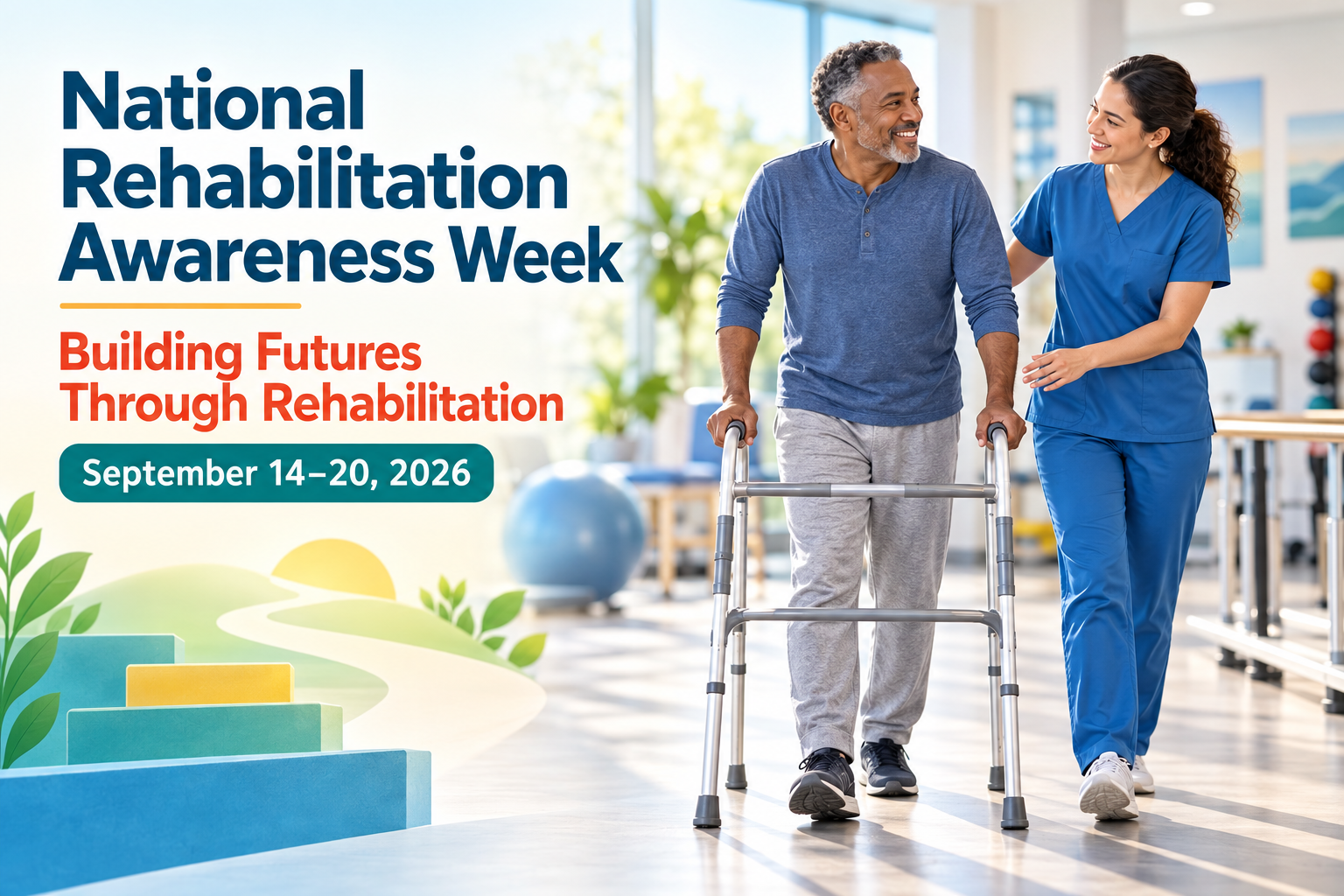
Each September, National Rehabilitation Awareness Week recognizes the remarkable impact rehabilitation can have on people recovering from illness, injury, surgery, or disabling conditions. In 2026, National Rehabilitation Awareness Week is observed September 14–20 under the theme “Building Futures Through Rehabilitation.”
Rehabilitation is about much more than recovering from an injury. At its heart, rehabilitation is about helping people regain abilities, adapt to changes, increase independence, and participate as fully as possible in everyday life.
For some, rehabilitation may mean learning to walk again after a serious accident or surgery. For others, it may involve relearning how to speak following a stroke, developing new ways to complete everyday activities after a spinal cord injury, improving strength after a prolonged hospitalization, or learning to use adaptive equipment that makes greater independence possible. The World Health Organization describes rehabilitation as an essential health service that helps people improve or maintain functioning when illness, injury, disability, surgery, or aging affects their ability to perform everyday activities. And the need is enormous. Globally, an estimated one in three people lives with a health condition that could benefit from rehabilitation.
Rehabilitation is a team effort. One of the greatest strengths of rehabilitation is its interdisciplinary approach. Depending on an individual's needs, a rehabilitation team may include physical medicine and rehabilitation physicians, rehabilitation nurses, physical therapists, occupational therapists, speech-language pathologists, social workers, case managers, psychologists, recreation therapists, prosthetists, orthotists, and other specialists. Each professional contributes something different. Physical therapists may work on strength, balance, mobility, transfers, endurance, and walking. Occupational therapists help people regain or adapt the skills needed for daily life, including dressing, bathing, cooking, working, and participating in activities that are personally meaningful. Speech-language pathologists may help people who experience difficulties with speech, language, cognition, communication, or swallowing.
Rehabilitation nurses provide specialized medical care while also helping patients learn how to manage medications, bowel and bladder care, skin protection, mobility, and other health needs. Together, these professionals establish goals with the individual and work toward something that can be difficult to measure on a medical chart: independence.
Progress doesn't always look the same. Recovery is rarely a straight line. There may be dramatic milestones, but rehabilitation is often made up of smaller victories that can mean everything to the person experiencing them. Standing for a few more seconds, taking another step, transferring safely from a wheelchair, buttoning a shirt independently, preparing a meal, speaking a word clearly, returning to work, driving again, learning to navigate the community using a mobility device or doing something independently that once required another person's help.
To someone watching from the outside, these accomplishments may appear small. To the individual who has spent weeks, months, or even years working toward them, they can represent an extraordinary amount of determination. Rehabilitation professionals understand the importance of those victories. They are often the people encouraging patients when progress feels slow and reminding them how far they have already come.
An important misconception about rehabilitation is that its only purpose is to restore someone to exactly the way they were before an illness or injury. Sometimes that is possible. Sometimes it isn't. Successful rehabilitation may instead mean helping someone discover a new way to live independently and meaningfully. Adaptive equipment, wheelchairs, prosthetic and orthotic devices, communication technology, home modifications, and new strategies for completing everyday activities can dramatically increase independence and participation. The goal becomes not simply returning to the past but building the best possible future.
That is what makes the 2026 theme, “Building Futures Through Rehabilitation,” especially meaningful. Rehabilitation Benefits More Than the Individual. The benefits of rehabilitation extend beyond the therapy room. According to the World Health Organization, rehabilitation can help prevent complications, shorten hospital stays, reduce hospital readmissions, and help people return to work, education, family life, and their communities. It can also help people remain independent in their own homes and reduce the need for long-term assistance. Rehabilitation therefore represents not only compassionate healthcare but an important investment in individuals, families, communities, and healthcare systems.
National Rehabilitation Awareness Week also gives us an opportunity to recognize the professionals who devote their careers to helping others reclaim pieces of their lives. Their work demands clinical knowledge, creativity, patience, encouragement, and an understanding that no two rehabilitation journeys are identical. Perhaps most importantly, rehabilitation professionals often see possibility at moments when their patients cannot yet see it themselves. They challenge. They encourage. They adapt. They celebrate. And then they challenge their patients again.
Behind nearly every rehabilitation success story is a team of professionals who refuse to stop looking for the next possibility. During National Rehabilitation Awareness Week, we recognize those professionals — and the millions of individuals who work alongside them every day to regain function, increase independence, overcome obstacles, and build their futures. Because rehabilitation is not simply about what a person has lost. It is about discovering what is still possible.
American Medical Rehabilitation Providers Association. (2026). National Rehabilitation Awareness Week. https://amrpa.org/national-rehabilitation-awareness-week/; Centers for Medicare & Medicaid Services. (2009). CMS adopts inpatient rehabilitation facility coverage requirements.https://www.cms.gov/newsroom/fact-sheets/cms-adopts-inpatient-rehabilitation-facility-coverage-requirements; World Health Organization. (2024). Rehabilitation: Questions and answers. https://www.who.int/news-room/questions-and-answers/item/rehabilitation; World Health Organization. (n.d.). Rehabilitation. https://www.who.int/health-topics/rehabilitation; World Health Organization. (2023). Package of interventions for rehabilitation. https://www.who.int/teams/noncommunicable-diseases/sensory-functions-disability-and-rehabilitation/rehabilitation/service-delivery/package-of-interventions-for-rehabilitation/; World Health Organization. (2026). Rehabilitation: A non-negotiable pillar of universal health coverage. https://www.who.int/publications/m/item/rehabilitation--a-non-negotiable-pillar-of-universal-health-coverage